Field of Science

Showing posts with label Viral evolution. Show all posts

What can flies tell us about #virusevolution?

Some of the fly species used in this study (thanks to Ben Longdon).
 What influences whether a parasite - for example a virus - will infect a new host and jump species? Is it more to do with the virus, or the host? Maybe something entirely different, like whether the two hosts will ever meet. Investigating these factors may allow us to predict how viruses will behave in their natural environment and aid us in determining the likelihood of transmission and spread into - and throughout - a new species, like us, humans. Imagine if we had had this knowledge earlier, we may have been able to prevent such epidemics HIV, SARS or the recurring ebola outbreaks. 

 Well, this is exactly what one group - joint between Edinburgh and Cambridge Universities in the UK - are doing. Get the PLoS Pathogens paper here. Using perhaps the only experimentally amenable model system for animals - which consisted of flies and their viruses - they recently provide evidence that the likelihood of a virus replicating within a new host has a lot to do with how genetically related it is to the original host species. And, surprisingly, in some cases it has not much at all to with it - further compounding the complexities of virus emergence. But how did they do it?

Uncovering a missing link in viral evolution - how did some get so big?

Vietnamese jungle.
  Out of the dense, tropical rainforest of Northern Vietnam, researchers have discovered a missing link in viral evolution. Through the large-scale screening of trapped mosquitoes, a joint Dutch and Japanese group may have identified the secrets of how one group of viruses - the nidoviruses - got really big. 

  This work potentially answers one of the more prevailing mysteries in viral evolution: how can RNA viruses escape the evolutionary restrictions placed on them by their very high mutation rates and get more complex? If you look closer though, more questions are thrown back than are answered.

  The positive-sense RNA viruses are an extremely large and diverse group of viruses, housing many known - and unknown - human pathogens and indeed many non-pathogenic, environmentally influential microbes. On the whole, these viruses don't get very big (see the graph below); having a genome made of RNA isn't particularly a good thing if you want to have a long genome, encoding lots of complex genes. The enzymes these viruses use to copy their genomes are nowhere near as accurate as their cellular counterparts. And, introducing mutations every few thousands nucleotides is bound to impact on your evolutionary potential and fitness.

Where did our smallpox vaccine come from?

Edward Jenner's smallpox vaccination
Bring to mind the now famous 'first scientific exploration of vaccination', when, in the late 1700's, Edward Jenner - an English physician - first came up with the idea of using a non-pathogenic cowpox virus to vaccinate people against its deadly relative, smallpox (variola virus). 

Well, this virus and others like it, such as vaccinia virus (and its own viral derivatives, like the highly attenuated modified vaccinia virus Ankara) have been used worldwide to protect human populations from contracting smallpox (See dryvax and it's recombinant clone ACAM2000), which resulted in the eradication of variola virus during the second half of last century. These viruses are thought to all trace there ancestry back to cowpox isolates from around Jenner's time in the late 1700's, yet we don't really know for 100% where they originated.

Despite its renowned success, showing society the power of vaccination, the origins of cowpox have so far remained elusive. The story goes that Jenner's original cowpox isolate, through generations and generations has somehow become what we know of as vaccinia virus but how is anyone's guess. Maybe recombination with other poxviruses out there or maybe it is the last living representative of an extinct virus is the reason why.

What human cowpox looks like
Now, an international team of researchers (see paper here) has shed light on it's origins by sequencing and studying whole genomes - contrary to the single-gene-centric studies in the past - of multiple currently circulating isolates of cowpox from around the world in order to uncover the secrets of poxvirus evolution in general.

Viruses are a haven of genetic diversity - even DNA viruses, which have been largely ignored on that front in favor of their more mutation-prone RNA cousins; this fact is no more apparent than in the case of poxviruses. These viruses, including smallpox and the re-emerging human pathogen monkeypox represent an immense amount of genotypic and phenotypic variation, which is in itself medically and evolutionarily important. Just think of the devastation that smallpox caused to the human population and have a look at what monkeypox has been up to.

False-color electron micrograph of vaccinia virus particle

This group compared the DNA of  the cowpox strains to other closely related pox viruses, such as: smallpox itself, monkeypox, camelpox and tatera pox (viruses which themselves have a difficult to trace past) as well as current vaccine vaccinia strains. They thus generated large phylogenetic trees based on the compared sequence and then mapped these onto a map of Europe to see if they could uncover some geographical pattern of cowpox evolution.


This analysis found an as yet unappreciated diversity hidden under what we called 'cowpox viruses' through identification of a number of well-defined monophyletic groups that should in their own rights be designated separate species. Interestingly, it also appears that our vaccine strain has jumped species to horses and buffalo as viruses isolated from these species have close relatives in vaccinia-like strains.

Cowpox viruses were found to cluster in two major groups - cowpox like and vaccinia virus like suggesting that our smallpox 'vaccinia' vaccine potentially originated as a cowpox virus (as we thought) yet it was endemic to mainland Europe, something that goes against the tale of Jenner's isolation of cowpox from the UK.

The authors suggest that further sampling of more isolates from within the UK and across Europe may clear up any taxonomic uncertainties here. What this work does highlight is the oft under appreciated diversity of large DNA viruses, especially the medically important pox viruses and the difficulties of doing evolutionary analysis on viruses which such large genomes who like to recombine with each other.


ResearchBlogging.orgCarroll, D., Emerson, G., Li, Y., Sammons, S., Olson, V., Frace, M., Nakazawa, Y., Czerny, C., Tryland, M., Kolodziejek, J., Nowotny, N., Olsen-Rasmussen, M., Khristova, M., Govil, D., Karem, K., Damon, I., & Meyer, H. (2011). Chasing Jenner's Vaccine: Revisiting Cowpox Virus Classification PLoS ONE, 6 (8) DOI: 10.1371/journal.pone.0023086

On the origins of smallpox - where and when did variola virus emerge?

ResearchBlogging.org2011 may be the year where the last known officially acknowledged stocks of the deadly smallpox virus, variola are destroyed - a virus that claimed over 500 million lives in the 20th century alone. The extensive collection of 'live' virus and DNA stocks totalling over 500 isolates/strains, which are held between the US Centres for Disease Control and the Russian State Research Centre of Virology and Biotechnology may be ordered to be eliminated following World Health Organisation (WHO) recommendations soon to be announced.

Although the impending fate of this pathogen has been covered elsewhere by Vincent Racaniello and Steven Salzberg I have been led to ponder its beginnings, at least in humans: where and when, over the course of human history did variola virus emerge  and have we always suffered from it? What confuses the matter further is that there are two clinical forms of smallpox - major (30% mortality) and minor, including both African and Alastrim minor (<1% mortality)- do these viruses have the same evolutionary history and if so, when and where did they diverge? Luckily, we can now study the origins of infectious diseases through both molecular and historical records.

A depiction of Shapona the west-African Yoruba god of smallpox. Courtesy James Gathany (photo), CDC/ Global Health Odyssey.
Conflicting historical records

It has been very confusing trying to make sense of the historical records of suspected smallpox cases as there are significant gaps in documentation and many conflicting reports. Smallpox-like skin lesions have been observed on Egyptian mummies dating from as far back as 1580 B.C yet there is no mention of the disease at all in the Old or New testaments nor even the Hippocratic texts. There was some mention of a smallpox-like disease in China and India as early as 1500 B.C but the only unmistakable description can be found from the 4th century A.D in China.  Interestingly there was no mention of smallpox in the American continents nor in sub-Saharan Africa prior to European exploration. But as shown in the picture above, smallpox has shaped west-African culture. So, did smallpox originate in Asia and spread to Egypt around 1,500 B.C? Or, is smallpox a relatively recent human disease, emerging around the 4th century A.D in Asia?

Molecular data shed light on variola evolution

A 2007 study using genomic data from the CDC's variola collections - the same ones that may soon be destroyed, added a phylogenetic perspective to the origins of smallpox and how it spread worldwide. Through studying single nucleotide polymorphisms (SNPs) from 47 variola genome isolates from geographically distant areas and collected between the 1940s and '60s they examined the genetic relatedness between isolates and were able to estimate the time since they shared a last common ancestor. They combined this DNA evidence with the above historical records to generate an idea as to where, when and how smallpox originated and spread throughout human populations.

Variola genome phylogeny

Abstract: Human disease likely attributable to variola virus (VARV), the etiologic agent of smallpox, has been reported in human populations for >2,000 years. VARV is unique among orthopoxviruses in that it is an exclusively human pathogen. Because VARV has a large, slowly evolving DNA genome, we were able to construct a robust phylogeny of VARV by analyzing concatenated single nucleotide polymorphisms (SNPs) from genome sequences of 47 VARV isolates with broad geographic distributions. Our results show two primary VARV clades, which likely diverged from an ancestral African rodent-borne variola-like virus either ≈16,000 or ≈68,000 years before present (YBP), depending on which historical records (East Asian or African) are used to calibrate the molecular clock. One primary clade was represented by the Asian VARV major strains, the more clinically severe form of smallpox, which spread from Asia either 400 or 1,600 YBP. Another primary clade included both alastrim minor, a phenotypically mild smallpox described from the American continents, and isolates from West Africa. This clade diverged from an ancestral VARV either 1,400 or 6,300 YBP, and then further diverged into two subclades at least 800 YBP. All of these analyses indicate that the divergence of alastrim and variola major occurred earlier than previously believed.


Hypothesised spread of variola worldwide
When analysed, variola fell into two large monophyletic clades signifying a historical divide in their genetic relatedness. The earliest representative - or most basal - of the variola major smallpox viruses are the Asian isolates. This suggests that major may have originated in Asia followed by geographic radiation across the Old world and into Africa. Using historical records as a means to calibrate variola evolutionary history, their results indicated that smallpox spread from Asia as much as 1,600 years ago which neatly backed up the historical records of 4th Century China. By the time smallpox reached out of East-Asia, the ancient Greek and Roman civilisations were no more - hinting that the reason they didn't observe smallpox was because at that time, in the Mediterranean region there wasn't any variola virus transmission. Despite this, analysis of the second major clade suggested a split 6,300 years ago placing variola well into ancient history. So, is smallpox a very old or relatively recent human pathogen? And, if so, where did it occur? The molecular data also showed that the clinically 'minor' forms of smallpox - African minor and Alastrim minor are very much related to the major viruses; evolutionarily speaking these viruses are thus very smilier.


A rodent origin of smallpox?

We can investigate the origin of smallpox through the molecular characterisation of other poxviruses. Variolataterapox virus) and camelpox viruses and they all are more related to each other than to other poxviruses, such as monkeypox. When their genomes were compared to that of variola, a time since divergence was estimated at between 16,000 and 68,000 years ago. As taterapox and camelpox are primarily found throughout Africa and Asia this suggests a possible origin of variola and the other poxviruses from ancient endemic poxviruses in Africa, possibly from rodents. Upon human infection this virus may have followed us out of Africa entering Asia and spreading across the globe. Or possibly, the virus emerged in rodent populations only to pop up again in Asia thousands of years later.

Although this period is quite a bit before the development of human agriculture and increased population density as is possibly required for such a highly infectious and lethal virus like smallpox to persist, the ancient variola virus might have behaved very differently from the one we know and fear. Sadly, we cannot say for sure exactly how and where variola emerged because we simply do not know a lot about the natural diversity of poxviruses in rodents or other mammal species and until we do, we will not have an accurate answer.

Future Pox?

Monkeypox from bushmeat? www.lynnjohnsonphoto.com/
What does this history of smallpox say about its impending eradication and the threat of a future virus emergence? Well, sometime in our ancient past variola virus emerged into prehistoric human populations and the data indicate that this may well have occurred within the African continent or nearby in Asia and it is likely that this same ancestral virus emerged into other mammalian species, such as Camels and Rodents. Smallpox then might have followed us through our journey out of Africa and became endemic in large population centres across the Eurasian landmass.

Although we have now effectively eradicated variola from the human population - and soon seek to destroy its last remaining stocks - might another poxvirus emerge just like it did before? We are now in a situation where the human population has very little immunity to variola and other related poxviruses, a situation which last would have existed prior to the initial emergence of smallpox. This provides ample breeding ground for novel poxviruses to emerge and fill the niche emptied by waning population immunity. Alarmingly, the rate of monkeypox infections - another rodent poxvirus - has been increasing (20X)  in the last 3 decades following cessation of smallpox vaccination. May this, or another related poxvirus, be the new smallpox? Could existing smallpox stocks not be used to study poxvirus/human interactions? May it be premature to destroy them in light of possible future pandemics? Only the WHO can decide later ths year.


Gubser C, & Smith GL (2002). The sequence of camelpox virus shows it is most closely related to variola virus, the cause of smallpox. The Journal of general virology, 83 (Pt 4), 855-72 PMID: 11907336

Li, Y., Carroll, D., Gardner, S., Walsh, M., Vitalis, E., & Damon, I. (2007). From the Cover: On the origin of smallpox: Correlating variola phylogenics with historical smallpox records Proceedings of the National Academy of Sciences, 104 (40), 15787-15792 DOI: 10.1073/pnas.0609268104

Raymond S. Weinstein (2011). Should Remaining Stockpiles of Smallpox Virus (Variola) Be Destroyed? Emerg Infect Dis, 17 (Apr) : 10.3201/eid1704.101865

Rimoin AW, Mulembakani PM, Johnston SC, Lloyd Smith JO, Kisalu NK, Kinkela TL, Blumberg S, Thomassen HA, Pike BL, Fair JN, Wolfe ND, Shongo RL, Graham BS, Formenty P, Okitolonda E, Hensley LE, Meyer H, Wright LL, & Muyembe JJ (2010). Major increase in human monkeypox incidence 30 years after smallpox vaccination campaigns cease in the Democratic Republic of Congo. Proceedings of the National Academy of Sciences of the United States of America, 107 (37), 16262-7 PMID: 20805472

The molecular domestication of amphibian retroviruses - do they play aphysiological role?


Xenopus tropicalis - do recently identified ERVs play a functional role?


ResearchBlogging.orgWe mostly think of viruses of being ‘bad’ and ‘dangerous’ yet there are countless examples of viruses playing a positive role in their host’s life. These symbiotic agents have been co-opted by the host to do something good; some viruses have even been inserted into our genomes and thus are forever tied to our germline and our descendants - sometimes even these viruses can do good. This is the kind of game evolution plays with our viral parasites and us – its generally pretty cruel and inconsiderate but every so often we get something good out of it.

One example of these endogenous viruses is the endogenous retroviruses or ERVs, which are somewhat related to the non-endogenous – ‘exogenous’ – retroviruses that can cause disease in us and other animals (HIV XMRV?). Just to put it into perspective, 8% of our genome is made up of these ERVs and they also make up a large chunk of other vertebrate genomes. The majority of these inserted retroviral genomes have been destroyed by the forces of evolution and thus bear little resemblance to their ‘wild’ cousins; they are not expressed and their sequence shows little homology to other retroviruses. However, some ERVs have changed very little, suggesting an important function may be conserving them – these are expressed and do sort of resemble the exogenous ones. The insertion of a novel ERV sequence into a host’s genome acts as evolutionary raw material allowing significant adaptive functions to arise and a great deal of evidence suggests they can these can even play a physiological role in host biology – this is known as molecular domestication. One interesting example is the ERV role in the mammalian placenta.


A recent paper reports the discovery and characterisation of an amphibian ERV whose genomic organisation is highly conserved making it a good candidate to have a novel physiological function. Investigating the genome of Xenopus tropicalis - an 'African clawed frog', the group discovered a unique DNA sequence that was highly related to a previously characterised Xenopus protein with frost-resistant functions - allowing winter survival in woodland frogs. This 9,551 base-pair DNA sequence not only contained the intact frost-resistant gene but also a full-length retroviral genome with the general organisation of many common ERVs – 5’ LTR-GAG-POL-ENV-3’LTR.

ABSTRACT: We report on the identification and characterization of XTERV1, a full-length endogenous retrovirus (ERV) within the genome of the western clawed frog (Xenopus tropicalis). XTERV1 contains all the basic genetic elements common to ERVs, including the classical 5'-long terminal repeat (LTR)-gag-pol-env-3'-LTR archi- tecture, as well as conserved functional motifs inherent to each retroviral protein. Using phylogenetic analysis, we show that XTERV1 is related to the Epsilonretrovirus genus. The X. tropicalis genome harbors a single full-length copy with intact gag and pol open reading frames that localizes to the centromeric region of chromosome 5. About 10 full-length defective copies of XTERV1 are found interspersed in the genome, and 2 of them could be assigned to chromosomes 1 and 3. We find that XTERV1 genes are zygotically transcribed in a regulated spatiotemporal manner during frog development, including metamorphosis. Moreover, XTERV1 transcription is upregulated under certain cellular stress conditions, including cytotoxic and metabolic stresses. Interestingly, XTERV1 Env is found to be homologous to FR47, a protein upregulated following cold exposure in the freeze-tolerant wood frog (Rana sylvatica). In addition, we find that R. sylvatica FR47 mRNA originated from a retroviral element. We discuss the potential role(s) of ERVs in physiological processes in vertebrates.

Following the characterisation of the genome sequence, the group looked whether there any more ERVs like this one in Xenopus genomes  to see if  this a rare example of a highly conserved ERV and were there any other examples of these sequences present? There turned out to be 59 genomic loci with some sort of homology to the newly found ERV however all had significant mutations present rendering them functionally inactive – at least where gene expression is concerned. These sequences were mapped onto Xenopus chromosomes, showing that the intact ERV was present on chromosome and the ‘damaged’ ones were found throughout the genome. This ERV is after all a lone agent in the Xenopus genome - confirmed by these experiments.

Phylogenetic studies were also carried out which suggested that primary retroviral integration occurred roughly 41 million years ago and from then on multiple rounds of movement around the genome or reinfection generated the many mutated copies around the genome. Their results also suggest that this ERV is actively replicating and inserting itself into the genome up to the present day. A cousin of this retrovirus was also found in the closely related X.laevis genome showing that integration occurred prior to the evolutionary separation of these two lineages.


They next turned their attention to whether this ERV had a functionally active role (is it transcribed; in what tissues and at what points in frog development?) in host biology as observed in other host/ERVs. Using real-time PCR and in situ hybridisaton techniques, the group were able to follow ERV expression throughout X. tropicalis development and assess the level of transcription and tissue localisation and possible infer a physiological function. They noted a highly regulated yet dynamic expression of gag, pol and env expression from fertilisation through metamorphosis (curiously a peak of activity was seen during metamorphosis) and adult life but does this control of expression actually mean something functional or is it merely physiological neutral? This ERV may just be replicating within the host genome without contributing something to host life. In order to understand this, they subjected X. tropicalis tadpoles or cell lines to a number of biological ‘stresses’ e.g. metabolic, temperature and UV stresses. An upregulation of ERV expression was seen upon metabolic and UV stresses and not in temperature – suggesting a fine tuning of its expression in response to a number of stresses. Whether this actually achieved something functionally was not investigated.


A recently discovered retrovirus derived gene in another frog species was found to play a role in protecting frog cells from the effects of freezing conditions. This study, on the backs of that investigation determined that frost-tolerant gene was derived from a highly conserved ERV present within Xenopus genomes. A distinct physiological role for these ERV-derived genes was not validated in this study yet in the future, further characterisation of its expression in vivo under temperature stress should be undertaken. This work underlines the importance that retroviruses and their endogenised cousins play in host cell functioning and evolution. Viruses are not all bad news – sometimes they can help you.

Roossinck, M. (2011). The good viruses: viral mutualistic symbioses Nature Reviews Microbiology, 9 (2), 99-108 DOI: 10.1038/nrmicro2491

Sinzelle, L., Carradec, Q., Paillard, E., Bronchain, O., & Pollet, N. (2010). Characterization of a Xenopus tropicalis Endogenous Retrovirus with Developmental and Stress-Dependent Expression Journal of Virology, 85 (5), 2167-2179 DOI: 10.1128/JVI.01979-10

Seeing the big picture of RNA virus evolution

This post was chosen as an Editor's Selection for ResearchBlogging.org

From both a medical and a scientific viewpoint, the evolution of viruses is extremely important to us;  viral adaptation to their ever changing environment is responsible for major morbidity and mortality worldwide so maybe studying this  may allow us to predict virus evolution in the future and may help prevent pandemics occuring?

We kind of know a lot about how viruses evolve at the small-scale; we know how viruses generally create genetic diversity - mutations - and how processes such as natural selection and genetic drift act on these genetic changes and influence the way viral genomes change over time. What we don't know however, is how viruses change at the larger-scale - how these above processes influence viral genomes over thousands of years, including: how and why viruses speciate, how their genome structure evolves and how and when do new viruses originate.

[caption id="" align="aligncenter" width="375" caption="An example phylogenetic tree - The paramyxoviridae containing a number of important human and animal pathogens. Notice the host/viral species distribution."][/caption]

A recent study, investigating the evolution of a number of RNA viruses has sought to reconcile this lack of understanding by attempting to assess virus 'macroevolution'- specifically viral speciation. By generating large and highly robust phylogenetic trees (using significantly highly conserved amino-acid sequences of a single viral protein) for 5 genera of RNA virus including: the Alphaviruses, Caliciviruses, Paramyxoviruses, Rhabdoviruses and the Flaviviruses, the team were able to map the host species of each virus species onto the trees and this allowed them to infer the mode of speciation of each virus genus.

More specifically they asked: Do closely related viral species infect the same host and are therefore believed to have speciated in that host or do they infect completely different hosts which are believed to have speciated following host jumping?

What is a virus species?


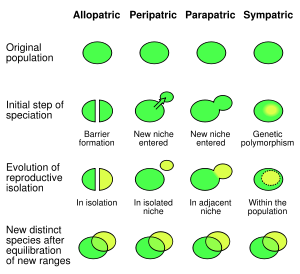
[caption id="" align="aligncenter" width="300" caption="General modes of speciation - we may think of viruses speciating by either allopatric (host shift) or sympatric (intra-host divergence)."][/caption]

The concept of the viral species has been a hard one to determine becuase viruses don't reproduce sexually. It is generally thought to be rather a arbitrary classification, however, most virus 'species' tend to be phylogenetically and often phenotypically stable genetic lineages and hence may be thought of as 'biological relevant'. We may think of viral speciation much like we think of speciation in the classic sense: allopatric or 'geographical speciation' (virus adaptation to a new host species) and sympatric - that not requiring the forces of georgaphic isolation (generation of viral speciation within a single host). Virus sympatric speciation requires the adapation to a new infectious niche within a host, for example a new lineage may infect new cell types within that host. Virus allopatric speciation requires host-jumping or adaptation to a new host altogether but may result from co-divergence follwoing host speciation. Both processes may result in two or more 'stable, phylogenetic and phenotypic genetic lineages. But what does the data say about it - how do viruses evolve in the real world?

What the data says


The results were split - at leats 50% were found to have 'speciated' via sympatric-like processes and half from allopatric-like processes. The group stress, however, that a major caveat of this study is that it highlights our limited understanding of what specific host speces particular viruses infect; in this study most hosts were classified as 'birds' or 'plants' or 'Carnivores' which limits the resolution of phylogenetic studies and leads to the overestimation of sympatric speciation events which would otherwise not exist if exact hosts were known. This leads us to put little confidence on our earlier 50/50 estimate and most likely the role of sympatric speciation would be a lot less important than allopatric modes of speciation in reality.

Why do RNA viruses evolve this way - What controls viral speciation?


So, we may say that most RNA virus speciation is caused by allopatric modes - or host jumping, but this may seem counterintuitive as there are some major barriers to viral emergence. The group argue, however, that it may take a lot more - genetically speaking - for a virus to speciate within a host than it does for a virus to jump species - eg. replicate in a new cell type/alter antigenic epitopes. The apparant preference for allopatric speciation may be controlled by intrinsic biological factors of these RNA viruses, namely: their extremely small genome size which effectively constrains evolutionary innovation. Those changes required for host jumping (change in receptor binding sites for instance) may be relatively minor when compared to those and the more closely related the host species are then the more easily host-jumping will occur - which is what we see here.

This study highlights the key role that viral 'allopatric' speciation or host - jumping plays in the evolution of RNA viruses yet further emphasizes the need to better study and understand viral biodiversity and host range in the wild - not only focusing on those medically important human viruses. Further research may be carried out on the molecular barriers to both cellular and host switching for these RNA viruses. This study will act as a model system that may be applied to other viral lineages - what about the RNA viruses with segmented genomes? What about the DNA viruses? Retroviruses?

ResearchBlogging.org
Kitchen A, Shackelton LA, & Holmes EC (2011). Family level phylogenies reveal modes of macroevolution in RNA viruses. Proceedings of the National Academy of Sciences of the United States of America, 108 (1), 238-43 PMID: 21173251