


Field of Science
-
-
Change of address1 year ago in Variety of Life
-
Change of address1 year ago in Catalogue of Organisms
-
-
Earth Day: Pogo and our responsibility1 year ago in Doc Madhattan
Showing posts with label Synthetic biology and genetic engineering. Show all posts
Showing posts with label Synthetic biology and genetic engineering. Show all posts
For US$16,818.50 would you want a synthetic human virus?

Can we use viruses to vaccinate against - and cure - established cancers?
Everyone is aware of the ability of our immune system to defend against microbial pathogens yet its role in the prevention of other diseases - like cancer - is generally over-looked. Yet it is through the harnessing of our immune system that novel ways of combating cancer may arise. And interestingly enough, through the use of engineered viruses - the same ones our immune system protects against - we may now control aspects of immunity to suit these medical needs. Kotke et al, report in Nature Medicine just this week, their use of a new virus-based immunotherapy platform that was able to effectively 'cure' mice suffering with cancer.
One of the hallmarks of cancer appears to be the ability to persist in the face of an active immune system - see fig. 1. Newly cancerous cells and tumours are able to survive and proliferate without - or at least protecting themselves - against a full-blown immune attack. Our immune system is usually able to protect us from the development of cancer but in some cases something fails and the result is more often than not - cancer.
Through the recognition of 'tumour antigens' (proteins expressed only on cancer cells) or 'tumour-associated antigens' (proteins expressed differently on cancer cells), our immune system is usually able to mount an effective response toward those cells. This is the system that tumours are able to suppress yet we may be able to boost the natural immunological nature of tumours in order to cure them. The discovery of these proteins - just like those found on the surface of virus particles or bacterial cells - may allow us to effectively vaccinate people against cancer, allowing their own immune system to remove the cancerous cells.
This is what we try and achieve through cancer vaccines and immunotherapies. Kotke et al set about trying to improve upon these current immunotherapy platforms, which - as they state - suffered from a number of problems including: lack of known tumour antigens and coverage of only a few such proteins. Most current immunotherapies rely upon the immunization with only a single antigen. Previous work by the group showed that if you kill normal cells from a patient in vivo - you may be able to elicit an effective anti-tumour immune response through the induction of tumour-associated antigen immunity (when cells die they either burst and release their insides).This work effectively showed that you could immunize with a wide range of tumour-associated antigens from normal cells and protect against cancer - both circumventing the above two problems.
To improve upon this model, they developed a virus-based platform for the expression of a wide range of tumour-associated antigens in vivo termed altered self antigen and epitope library (ASEL) - see fig 3. They based their method upon the vesicular stromatitis virus - or VSV - normally a virus solely of livestock that also has the ability to infect humans. In humans it causes a generally mild flu-like illness and may form vesicles on the skin. Although a single-stranded non-segmented negative sense RNA virus, we have the ability to generate infectious VSV particles entirely from cDNA plasmids encoding the entire VSV genome. This has facilitated the development of VSV as a key eukaryotic expression vector for multiple uses, such as these cancer immunotherapies and specifically, as an oncolytic treatment. Using standard molecular biology techniques (PCR, restriction enzyme digests and ligations) you can insert any gene from whatever source you want into the VSV genome and it will be expressed inside cells following infection. The benefit with using this virus is that even without the expression of tumour antigens from it's genome, replication within a cell will kill the cell anyway. It is a double hit strategy.
In order to express hundreds of tumour-associated antigen genes, the group used reverse-transcriptase PCR to amplify all expressed genes from normal prostate tissue and inserted the entire normal prostate tissue cDNA library into VSV. They were then able to infect mice that suffered with prostate cancer and observe what happened to their tumours - specifcally, was an effective immune response generated and did the tumour shrink? VSV virus particles were injected into the mice, virus entered the cells of the mice and began to replicate and express their genes, including the newly inserted prostate cDNA. Essentially, thousands of virus particles were adminsired, each containing a slightly different gene from the prostate cDNA library. High levels of tumour associated antigens were therfore being expressed in mice allowing for the generation of an effective immune response.
This approached effectively cured the mice who suffered from prostate cancer. Following this treatment a number of resistant tumours emerged which were again subjected to a further treatment using a cDNA library taken from the tumour itself this time and this readily treated the secondary resistant cancers. The clinical benefits of this approach can hardly go unnoticed. The ability to administer a broad tailored therapy that has the potential to cure an established tumour will be revolutionary, especially given the relative ease at which this can be developed 'at the bedside'. The ability to easily genetically manipulate viruses has - and will continue to - revolutionise the medical sciences. Look out for the eminent clinical trials.
 Kottke, T., Errington, F., Pulido, J., Galivo, F., Thompson, J., Wongthida, P., Diaz, R., Chong, H., Ilett, E., Chester, J., Pandha, H., Harrington, K., Selby, P., Melcher, A., & Vile, R. (2011). Broad antigenic coverage induced by vaccination with virus-based cDNA libraries cures established tumors Nature Medicine DOI: 10.1038/nm.2390
One of the hallmarks of cancer appears to be the ability to persist in the face of an active immune system - see fig. 1. Newly cancerous cells and tumours are able to survive and proliferate without - or at least protecting themselves - against a full-blown immune attack. Our immune system is usually able to protect us from the development of cancer but in some cases something fails and the result is more often than not - cancer.
 |
| Fig 1. Newly recognised cancer hallmarks - note avoiding immune destruction. (Hanahan and Weinberg 2011). |
Through the recognition of 'tumour antigens' (proteins expressed only on cancer cells) or 'tumour-associated antigens' (proteins expressed differently on cancer cells), our immune system is usually able to mount an effective response toward those cells. This is the system that tumours are able to suppress yet we may be able to boost the natural immunological nature of tumours in order to cure them. The discovery of these proteins - just like those found on the surface of virus particles or bacterial cells - may allow us to effectively vaccinate people against cancer, allowing their own immune system to remove the cancerous cells.
This is what we try and achieve through cancer vaccines and immunotherapies. Kotke et al set about trying to improve upon these current immunotherapy platforms, which - as they state - suffered from a number of problems including: lack of known tumour antigens and coverage of only a few such proteins. Most current immunotherapies rely upon the immunization with only a single antigen. Previous work by the group showed that if you kill normal cells from a patient in vivo - you may be able to elicit an effective anti-tumour immune response through the induction of tumour-associated antigen immunity (when cells die they either burst and release their insides).This work effectively showed that you could immunize with a wide range of tumour-associated antigens from normal cells and protect against cancer - both circumventing the above two problems.
 |
| VSV particles - www.standford.edu |
 |
| Fig.3. Cloning the cDNA library into the VSV genome in forward and reverse orientations = VSV-ASEL library |
In order to express hundreds of tumour-associated antigen genes, the group used reverse-transcriptase PCR to amplify all expressed genes from normal prostate tissue and inserted the entire normal prostate tissue cDNA library into VSV. They were then able to infect mice that suffered with prostate cancer and observe what happened to their tumours - specifcally, was an effective immune response generated and did the tumour shrink? VSV virus particles were injected into the mice, virus entered the cells of the mice and began to replicate and express their genes, including the newly inserted prostate cDNA. Essentially, thousands of virus particles were adminsired, each containing a slightly different gene from the prostate cDNA library. High levels of tumour associated antigens were therfore being expressed in mice allowing for the generation of an effective immune response.
 |
| Survival of mice treated with the VSV viruses - GFP expressing negative control; and the VSV ASEL in mice with established 'TC2' prostate tumours. |
This approached effectively cured the mice who suffered from prostate cancer. Following this treatment a number of resistant tumours emerged which were again subjected to a further treatment using a cDNA library taken from the tumour itself this time and this readily treated the secondary resistant cancers. The clinical benefits of this approach can hardly go unnoticed. The ability to administer a broad tailored therapy that has the potential to cure an established tumour will be revolutionary, especially given the relative ease at which this can be developed 'at the bedside'. The ability to easily genetically manipulate viruses has - and will continue to - revolutionise the medical sciences. Look out for the eminent clinical trials.
Kottke, T., Errington, F., Pulido, J., Galivo, F., Thompson, J., Wongthida, P., Diaz, R., Chong, H., Ilett, E., Chester, J., Pandha, H., Harrington, K., Selby, P., Melcher, A., & Vile, R. (2011). Broad antigenic coverage induced by vaccination with virus-based cDNA libraries cures established tumors Nature Medicine DOI: 10.1038/nm.2390
Viral nanotechnology - at the virus-chemistry interface
Viruses cause death and disease - Avian Influenza, Swine-origin Influenza, HIV, HPV, measles..... its hard to imagine viruses doing anything else - right?
But viruses don't have to cause disease - they can infect, replicate and exit without the host even realising it was there. Another view of viral infection is that we can exploit this very nature of viruses for our own means - meet: viral engineering (one flavour of biologically inspired nanotechnology).
[caption id="" align="aligncenter" width="352" caption="Viral nanoparticles: the diversity"]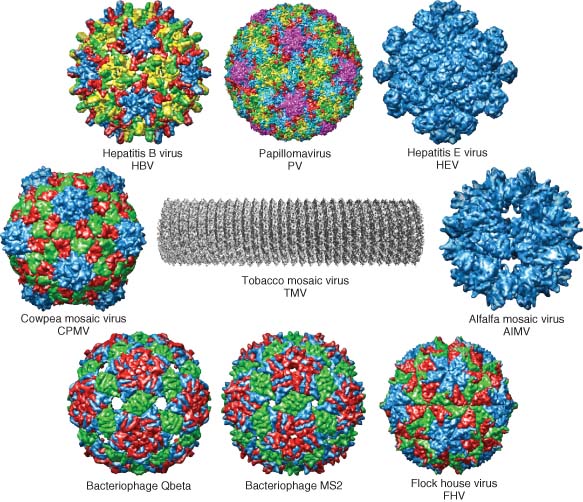 [/caption]
Viruses are basically self-assembling storage containers that can enter and exit cells and deliver their contents, they are very small, are biodegradable, can be modified (relatively) easily and have an excellent ability to travel around the human body - one big bonus is that in some cases (plant viruses) they are also extremely cheap.
A recent review describes these 'viral-nanoparticles' (VNPs) as:
Of course there are many caveats with these applications such as we would have to thoroughly test the toxicity (including cell death and immunogenicity) of such VNPs as human pathogens may have been used as the basis of the design, although the use of plant viruses may circumvent these dangers. The pharmacokinetics, infectivity and replication of viruses will be assessed in animal models prior to use as so will the stability in both a physical and genetic sense. Yet there are plenty of uses for VNPs that would not have to be anywhere near a human patient.
Despite these difficulties, we have a great chance of developing improved VNPs through the application of genetic engineering and chemical modifications, allowing us to generate novel combinations of genes and properties into a single viral particle. We no longer have to rely on 'wild-type' virus genomes - we can improve on what is out there. By applying a better understanding of natural viral pathogenesis including cell entry, replication, gene expression, cellular tropism and immunomodulation we should be able to rationally design safer, more efficacious and cheaper VNPs for whatever purpose we want. We can now begin to think of viruses as a novel materal that can altered to generate improved properties and thinking this way should open up many possibilities for medicine, industry and science. This is a basic tenet of synthetic biology.
Synthetic biology meet virology.

As of today, this research has been moving at an extremely fast pace - viruses are now used in cancer treatments, bacteriophages have been used to kill off bacterial infections, viruses have been applied in materials science, improved electronics have been developed using viral particles and targeted viruses have been used in biomedical imaging technology. Yet as our understanding of virus/host interactions increases and research on the applications of these VNPs begins to move from in vitro to in vivo investigations we will see more and more uses for these novel materials in both the clinic and in industry. Look forward to the future of viral nanotechnology!
As the review finishes off:
N.F. Steinmetz, Viral nanoparticles as platforms for next-generation therapeutics and imaging devices. Nanomedicine: NBM 2010;6:634-641, doi:10.1016/j.nano.2010.04.005
But viruses don't have to cause disease - they can infect, replicate and exit without the host even realising it was there. Another view of viral infection is that we can exploit this very nature of viruses for our own means - meet: viral engineering (one flavour of biologically inspired nanotechnology).
[caption id="" align="aligncenter" width="352" caption="Viral nanoparticles: the diversity"]
[/caption]Viruses are basically self-assembling storage containers that can enter and exit cells and deliver their contents, they are very small, are biodegradable, can be modified (relatively) easily and have an excellent ability to travel around the human body - one big bonus is that in some cases (plant viruses) they are also extremely cheap.
A recent review describes these 'viral-nanoparticles' (VNPs) as:
....dynamic, self-assembling systems that form highly symmetrical, polyvalent, and monodisperse structures. They are exceptionally robust, they can be produced in large quantities in short time, and they present programmable scaffolds. VNPs offer advantages over synthetic nanomaterials, primarily because they are biocompatible and biodegradable. VNPs derived from plant viruses and bacteriophages are particularly advantageous, because they are less likely to be pathogenic in humans and therefore less likely to induce undesirable side effects.
Of course there are many caveats with these applications such as we would have to thoroughly test the toxicity (including cell death and immunogenicity) of such VNPs as human pathogens may have been used as the basis of the design, although the use of plant viruses may circumvent these dangers. The pharmacokinetics, infectivity and replication of viruses will be assessed in animal models prior to use as so will the stability in both a physical and genetic sense. Yet there are plenty of uses for VNPs that would not have to be anywhere near a human patient.
Despite these difficulties, we have a great chance of developing improved VNPs through the application of genetic engineering and chemical modifications, allowing us to generate novel combinations of genes and properties into a single viral particle. We no longer have to rely on 'wild-type' virus genomes - we can improve on what is out there. By applying a better understanding of natural viral pathogenesis including cell entry, replication, gene expression, cellular tropism and immunomodulation we should be able to rationally design safer, more efficacious and cheaper VNPs for whatever purpose we want. We can now begin to think of viruses as a novel materal that can altered to generate improved properties and thinking this way should open up many possibilities for medicine, industry and science. This is a basic tenet of synthetic biology.
Synthetic biology meet virology.
As of today, this research has been moving at an extremely fast pace - viruses are now used in cancer treatments, bacteriophages have been used to kill off bacterial infections, viruses have been applied in materials science, improved electronics have been developed using viral particles and targeted viruses have been used in biomedical imaging technology. Yet as our understanding of virus/host interactions increases and research on the applications of these VNPs begins to move from in vitro to in vivo investigations we will see more and more uses for these novel materials in both the clinic and in industry. Look forward to the future of viral nanotechnology!
As the review finishes off:
The virus-chemistry interface remains an exciting place to be!
N.F. Steinmetz, Viral nanoparticles as platforms for next-generation therapeutics and imaging devices. Nanomedicine: NBM 2010;6:634-641, doi:10.1016/j.nano.2010.04.005
Subscribe to:
Posts (Atom)