Field of Science

Showing posts with label Genetic diversity. Show all posts

HIV restriction factor blocks respiratory viruses - but not how we thought

Measles virus - is it targeted by an HIV restriction factor?
Cellular organisms have evolved multiple defences to keep viruses and other genetic parasites at bay. One such shield is the development of an advanced adaptive immune system seen in vertebrates while another is the more evolutionary widespread 'innate' system made up of various expressed proteins and small RNAs. These molecules prevent particular stages of the viral replication cycle like entry, replication or exit. 

Another mechanism is to mutate the virus out of existence, i.e. change nucleotides throughout the viral genome so much so as to effectively knock-out that protein's function during infection and slow down replication so much so to allow your bodies' other defences to clear it. Since 2002 we have had tantalising clues that this is functioning during a viral infection, particular HIV and other retroviruses:

Isolation of a human gene that inhibits HIV-1 infection and is suppressed by the viral Vif protein.


Are microbes evolving to escape vaccination?

What if all those vaccines - those ones that work really well - all stopped working? Imagine if the viruses and bacteria from which they are trying to protect you against, evolved and adapted to life in a largely immune population? Those robust antibody and T cell responses generated within a person following vaccination supply the perfect breeding ground for the selection of resistant mutants where anibodies can no longer recognise and neutralize their targets and where T cells fail to eliminate infected cells. So, is it possible and is it happening?

Well, we already know this kind of phenomenon from influenza, right? Every year we have to change the strains that are put into your flu jab to match those viruses predicted to be circulating come winter. This is based on generating an antigenic match of vaccine to wild virus; specifically, their surface HA proteins must look the same. This is why there has been such a push to develop universal influenza vaccines capable of immunizing people against all flu strains. For viruses like measles and mumps however, we have our universal vaccine, or at least we thought we did.

Influenza may change through antigenic drift and shift forcing us to develop new vaccines each year, but do other viruses evolve through antigenic drift and force us to generate improved vaccines for them? http://news.bbc.co.uk/

#vaccines - can you predict how well they'll work?

 
Vaccines are great aren't they -  they offer us probably the most cost-effective means of reducing death and suffering on a worldwide scale that extends to both humans and other animals. The problem is that it's never been as easy as just dreaming up a vaccine for the latest virus to afflict us. Effective vaccines are extremely difficult to produce, even for the most well-researched pathogens and, even when you do develop one, plow billions into it's generation and testing, and get it successfully through all the necessary clinical trials it still might not work so perfectly. 

How dangerous are viral quasispecies?

Chikungunya virus particles emerging from an infected cell - is genetic diversity important to this virus?
  

   At around 1 mutation per 1,000 - 100,000 nucleotides per round of replication, RNA viruses have the highest mutation rate of anything seen in nature to date. During an infection of a single cell, thousands of new genomes are produced that will go on to make new virus particles; each genome will differ from another at most maybe 10 nucleotides (given an average virus of 10 kilobases in length). 

On the origins of smallpox - where and when did variola virus emerge?

ResearchBlogging.org2011 may be the year where the last known officially acknowledged stocks of the deadly smallpox virus, variola are destroyed - a virus that claimed over 500 million lives in the 20th century alone. The extensive collection of 'live' virus and DNA stocks totalling over 500 isolates/strains, which are held between the US Centres for Disease Control and the Russian State Research Centre of Virology and Biotechnology may be ordered to be eliminated following World Health Organisation (WHO) recommendations soon to be announced.

Although the impending fate of this pathogen has been covered elsewhere by Vincent Racaniello and Steven Salzberg I have been led to ponder its beginnings, at least in humans: where and when, over the course of human history did variola virus emerge  and have we always suffered from it? What confuses the matter further is that there are two clinical forms of smallpox - major (30% mortality) and minor, including both African and Alastrim minor (<1% mortality)- do these viruses have the same evolutionary history and if so, when and where did they diverge? Luckily, we can now study the origins of infectious diseases through both molecular and historical records.

A depiction of Shapona the west-African Yoruba god of smallpox. Courtesy James Gathany (photo), CDC/ Global Health Odyssey.
Conflicting historical records

It has been very confusing trying to make sense of the historical records of suspected smallpox cases as there are significant gaps in documentation and many conflicting reports. Smallpox-like skin lesions have been observed on Egyptian mummies dating from as far back as 1580 B.C yet there is no mention of the disease at all in the Old or New testaments nor even the Hippocratic texts. There was some mention of a smallpox-like disease in China and India as early as 1500 B.C but the only unmistakable description can be found from the 4th century A.D in China.  Interestingly there was no mention of smallpox in the American continents nor in sub-Saharan Africa prior to European exploration. But as shown in the picture above, smallpox has shaped west-African culture. So, did smallpox originate in Asia and spread to Egypt around 1,500 B.C? Or, is smallpox a relatively recent human disease, emerging around the 4th century A.D in Asia?

Molecular data shed light on variola evolution

A 2007 study using genomic data from the CDC's variola collections - the same ones that may soon be destroyed, added a phylogenetic perspective to the origins of smallpox and how it spread worldwide. Through studying single nucleotide polymorphisms (SNPs) from 47 variola genome isolates from geographically distant areas and collected between the 1940s and '60s they examined the genetic relatedness between isolates and were able to estimate the time since they shared a last common ancestor. They combined this DNA evidence with the above historical records to generate an idea as to where, when and how smallpox originated and spread throughout human populations.

Variola genome phylogeny

Abstract: Human disease likely attributable to variola virus (VARV), the etiologic agent of smallpox, has been reported in human populations for >2,000 years. VARV is unique among orthopoxviruses in that it is an exclusively human pathogen. Because VARV has a large, slowly evolving DNA genome, we were able to construct a robust phylogeny of VARV by analyzing concatenated single nucleotide polymorphisms (SNPs) from genome sequences of 47 VARV isolates with broad geographic distributions. Our results show two primary VARV clades, which likely diverged from an ancestral African rodent-borne variola-like virus either ≈16,000 or ≈68,000 years before present (YBP), depending on which historical records (East Asian or African) are used to calibrate the molecular clock. One primary clade was represented by the Asian VARV major strains, the more clinically severe form of smallpox, which spread from Asia either 400 or 1,600 YBP. Another primary clade included both alastrim minor, a phenotypically mild smallpox described from the American continents, and isolates from West Africa. This clade diverged from an ancestral VARV either 1,400 or 6,300 YBP, and then further diverged into two subclades at least 800 YBP. All of these analyses indicate that the divergence of alastrim and variola major occurred earlier than previously believed.


Hypothesised spread of variola worldwide
When analysed, variola fell into two large monophyletic clades signifying a historical divide in their genetic relatedness. The earliest representative - or most basal - of the variola major smallpox viruses are the Asian isolates. This suggests that major may have originated in Asia followed by geographic radiation across the Old world and into Africa. Using historical records as a means to calibrate variola evolutionary history, their results indicated that smallpox spread from Asia as much as 1,600 years ago which neatly backed up the historical records of 4th Century China. By the time smallpox reached out of East-Asia, the ancient Greek and Roman civilisations were no more - hinting that the reason they didn't observe smallpox was because at that time, in the Mediterranean region there wasn't any variola virus transmission. Despite this, analysis of the second major clade suggested a split 6,300 years ago placing variola well into ancient history. So, is smallpox a very old or relatively recent human pathogen? And, if so, where did it occur? The molecular data also showed that the clinically 'minor' forms of smallpox - African minor and Alastrim minor are very much related to the major viruses; evolutionarily speaking these viruses are thus very smilier.


A rodent origin of smallpox?

We can investigate the origin of smallpox through the molecular characterisation of other poxviruses. Variolataterapox virus) and camelpox viruses and they all are more related to each other than to other poxviruses, such as monkeypox. When their genomes were compared to that of variola, a time since divergence was estimated at between 16,000 and 68,000 years ago. As taterapox and camelpox are primarily found throughout Africa and Asia this suggests a possible origin of variola and the other poxviruses from ancient endemic poxviruses in Africa, possibly from rodents. Upon human infection this virus may have followed us out of Africa entering Asia and spreading across the globe. Or possibly, the virus emerged in rodent populations only to pop up again in Asia thousands of years later.

Although this period is quite a bit before the development of human agriculture and increased population density as is possibly required for such a highly infectious and lethal virus like smallpox to persist, the ancient variola virus might have behaved very differently from the one we know and fear. Sadly, we cannot say for sure exactly how and where variola emerged because we simply do not know a lot about the natural diversity of poxviruses in rodents or other mammal species and until we do, we will not have an accurate answer.

Future Pox?

Monkeypox from bushmeat? www.lynnjohnsonphoto.com/
What does this history of smallpox say about its impending eradication and the threat of a future virus emergence? Well, sometime in our ancient past variola virus emerged into prehistoric human populations and the data indicate that this may well have occurred within the African continent or nearby in Asia and it is likely that this same ancestral virus emerged into other mammalian species, such as Camels and Rodents. Smallpox then might have followed us through our journey out of Africa and became endemic in large population centres across the Eurasian landmass.

Although we have now effectively eradicated variola from the human population - and soon seek to destroy its last remaining stocks - might another poxvirus emerge just like it did before? We are now in a situation where the human population has very little immunity to variola and other related poxviruses, a situation which last would have existed prior to the initial emergence of smallpox. This provides ample breeding ground for novel poxviruses to emerge and fill the niche emptied by waning population immunity. Alarmingly, the rate of monkeypox infections - another rodent poxvirus - has been increasing (20X)  in the last 3 decades following cessation of smallpox vaccination. May this, or another related poxvirus, be the new smallpox? Could existing smallpox stocks not be used to study poxvirus/human interactions? May it be premature to destroy them in light of possible future pandemics? Only the WHO can decide later ths year.


Gubser C, & Smith GL (2002). The sequence of camelpox virus shows it is most closely related to variola virus, the cause of smallpox. The Journal of general virology, 83 (Pt 4), 855-72 PMID: 11907336

Li, Y., Carroll, D., Gardner, S., Walsh, M., Vitalis, E., & Damon, I. (2007). From the Cover: On the origin of smallpox: Correlating variola phylogenics with historical smallpox records Proceedings of the National Academy of Sciences, 104 (40), 15787-15792 DOI: 10.1073/pnas.0609268104

Raymond S. Weinstein (2011). Should Remaining Stockpiles of Smallpox Virus (Variola) Be Destroyed? Emerg Infect Dis, 17 (Apr) : 10.3201/eid1704.101865

Rimoin AW, Mulembakani PM, Johnston SC, Lloyd Smith JO, Kisalu NK, Kinkela TL, Blumberg S, Thomassen HA, Pike BL, Fair JN, Wolfe ND, Shongo RL, Graham BS, Formenty P, Okitolonda E, Hensley LE, Meyer H, Wright LL, & Muyembe JJ (2010). Major increase in human monkeypox incidence 30 years after smallpox vaccination campaigns cease in the Democratic Republic of Congo. Proceedings of the National Academy of Sciences of the United States of America, 107 (37), 16262-7 PMID: 20805472

Seeing the big picture of RNA virus evolution

This post was chosen as an Editor's Selection for ResearchBlogging.org

From both a medical and a scientific viewpoint, the evolution of viruses is extremely important to us;  viral adaptation to their ever changing environment is responsible for major morbidity and mortality worldwide so maybe studying this  may allow us to predict virus evolution in the future and may help prevent pandemics occuring?

We kind of know a lot about how viruses evolve at the small-scale; we know how viruses generally create genetic diversity - mutations - and how processes such as natural selection and genetic drift act on these genetic changes and influence the way viral genomes change over time. What we don't know however, is how viruses change at the larger-scale - how these above processes influence viral genomes over thousands of years, including: how and why viruses speciate, how their genome structure evolves and how and when do new viruses originate.

[caption id="" align="aligncenter" width="375" caption="An example phylogenetic tree - The paramyxoviridae containing a number of important human and animal pathogens. Notice the host/viral species distribution."][/caption]

A recent study, investigating the evolution of a number of RNA viruses has sought to reconcile this lack of understanding by attempting to assess virus 'macroevolution'- specifically viral speciation. By generating large and highly robust phylogenetic trees (using significantly highly conserved amino-acid sequences of a single viral protein) for 5 genera of RNA virus including: the Alphaviruses, Caliciviruses, Paramyxoviruses, Rhabdoviruses and the Flaviviruses, the team were able to map the host species of each virus species onto the trees and this allowed them to infer the mode of speciation of each virus genus.

More specifically they asked: Do closely related viral species infect the same host and are therefore believed to have speciated in that host or do they infect completely different hosts which are believed to have speciated following host jumping?

What is a virus species?


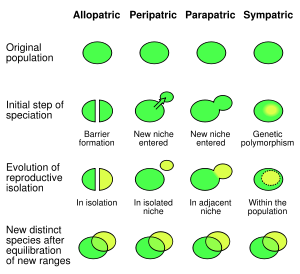
[caption id="" align="aligncenter" width="300" caption="General modes of speciation - we may think of viruses speciating by either allopatric (host shift) or sympatric (intra-host divergence)."][/caption]

The concept of the viral species has been a hard one to determine becuase viruses don't reproduce sexually. It is generally thought to be rather a arbitrary classification, however, most virus 'species' tend to be phylogenetically and often phenotypically stable genetic lineages and hence may be thought of as 'biological relevant'. We may think of viral speciation much like we think of speciation in the classic sense: allopatric or 'geographical speciation' (virus adaptation to a new host species) and sympatric - that not requiring the forces of georgaphic isolation (generation of viral speciation within a single host). Virus sympatric speciation requires the adapation to a new infectious niche within a host, for example a new lineage may infect new cell types within that host. Virus allopatric speciation requires host-jumping or adaptation to a new host altogether but may result from co-divergence follwoing host speciation. Both processes may result in two or more 'stable, phylogenetic and phenotypic genetic lineages. But what does the data say about it - how do viruses evolve in the real world?

What the data says


The results were split - at leats 50% were found to have 'speciated' via sympatric-like processes and half from allopatric-like processes. The group stress, however, that a major caveat of this study is that it highlights our limited understanding of what specific host speces particular viruses infect; in this study most hosts were classified as 'birds' or 'plants' or 'Carnivores' which limits the resolution of phylogenetic studies and leads to the overestimation of sympatric speciation events which would otherwise not exist if exact hosts were known. This leads us to put little confidence on our earlier 50/50 estimate and most likely the role of sympatric speciation would be a lot less important than allopatric modes of speciation in reality.

Why do RNA viruses evolve this way - What controls viral speciation?


So, we may say that most RNA virus speciation is caused by allopatric modes - or host jumping, but this may seem counterintuitive as there are some major barriers to viral emergence. The group argue, however, that it may take a lot more - genetically speaking - for a virus to speciate within a host than it does for a virus to jump species - eg. replicate in a new cell type/alter antigenic epitopes. The apparant preference for allopatric speciation may be controlled by intrinsic biological factors of these RNA viruses, namely: their extremely small genome size which effectively constrains evolutionary innovation. Those changes required for host jumping (change in receptor binding sites for instance) may be relatively minor when compared to those and the more closely related the host species are then the more easily host-jumping will occur - which is what we see here.

This study highlights the key role that viral 'allopatric' speciation or host - jumping plays in the evolution of RNA viruses yet further emphasizes the need to better study and understand viral biodiversity and host range in the wild - not only focusing on those medically important human viruses. Further research may be carried out on the molecular barriers to both cellular and host switching for these RNA viruses. This study will act as a model system that may be applied to other viral lineages - what about the RNA viruses with segmented genomes? What about the DNA viruses? Retroviruses?

ResearchBlogging.org
Kitchen A, Shackelton LA, & Holmes EC (2011). Family level phylogenies reveal modes of macroevolution in RNA viruses. Proceedings of the National Academy of Sciences of the United States of America, 108 (1), 238-43 PMID: 21173251

Massively parallel sequencing meets the vaccine industry

Live attenuated vaccines (LAVS), such as those produced for measles, mumps and influenza viruses, must have both high safety and immunogenicity if we are ever going to prevent human infection. Those vaccines, which are deemed unsafe, will be withdrawn resulting in low uptake and increased pathogen transmission and those vaccines which are poorly immunogenic, will not be  protective and result in pathogen transmission and significant disease

The key to easily predicting how safe a vaccine is – and also how immunogenic -, may lie in our ability to infer the phenotype (safety in humans) from the genotype (nucleic acid sequence). One problem with this is the inherent genetic instability of  RNA viruses; viruses such as polio, measles and mumps which are responsible for considerable disease in humans and which we vaccinate millions of people worldwide each year. This genetic instability results in what is generally considered as a viral ‘qausipecies’; a cloud-like structure in viral genome sequence space that can have multiple phenotypic properties: one being the safety, or lack of in humans. One example is that of oral polio vaccine strains which during production in tissue culture can accumulate genomic changes resulting in neurovirulence in humans.

In order to assess the safety we must therefore assay the genetic consistency or the types and frequency of particular changes in our vaccines prior to human administration to avoid vaccine induced disease. As I mentioned previously, our ability to assess the safety relies on our means of predicting phenotype from genotype, something that for most viruses is particularly difficult and time consuming. We are therefore  in a position in which we do not know the genetic determinants of safety and so cannot predict it based on nucleic acid sequence.

[caption id="" align="aligncenter" width="257" caption="MPS analysis of two batches of type 3 OPV performed by pyrosequencing. (A) The number of times each nucleotide was read in forward (green) and reverse (red) orientations. (B and C) Mutational profiles for vaccine batches that failed and passed the MNVT, respectively. Here and in all other figures the contents of mutants is shown by colored bars: mutations to A shown in orange, mutations to C in red, mutations to G in blue, and mutations to U in green. Neverov & Chumakov.(2010)"][/caption]

Neverov and Chumakov, from the American Food and Drug association (FDA) recently published a method in which massively parallel sequencing (MPS) is used to accurately and rapidly quantify nucleotide changes across entire poliovirus vaccine genomes.  This method proved to be very sensitive at detecting low frequency changes, changes that may have led to disease in humans. The group put forward the view that we do not truly have to know the direct relationship between genome sequence and safety but what we can do is compare the genotype and frequency of each change with previous ‘safe’ vaccine sequences. Vaccines will be allowed for human use if they have similar viral populations as a previously used strain. They offer this method as a replacement to the slower and less accurate mutant analysis by PCR and restriction enzyme cleavage (MAPREC) method.

The authors admit that the wide-scale implementation of MPS will be inhibited by the high running cost of the equipment.; a cost that they say is much less than the previously used primate neuroviruelance assay. Investment in this technology is expected to lead to a rapid decrease in price and hence will result in increased uptake of this in LAV production worldwide. Neverov and Chumakov have applied this novel sequencing technology to an important area of the vaccine industry. This application will find use in not only polio vaccines but in other LAV production and may also be implemented in the discovery of new genetic determinants of viral safety and immunogenicity.

Neverov, Alexander, and Konstantin Chumakov. 2010. Massively parallel sequencing for monitoring genetic consistency and quality control of live viral vaccines. Proceedings of the National Academy of Sciences of the United States of America 107, no. 46 (November). doi:10.1073